
“Because It Shows Your N*pples”
A blog post from DDA Editor-At-Large Emma Shapiro, reflecting on the moment that brought her into the anti-art-censorship and Free The Nipple movements, and the power of asking “Why?”
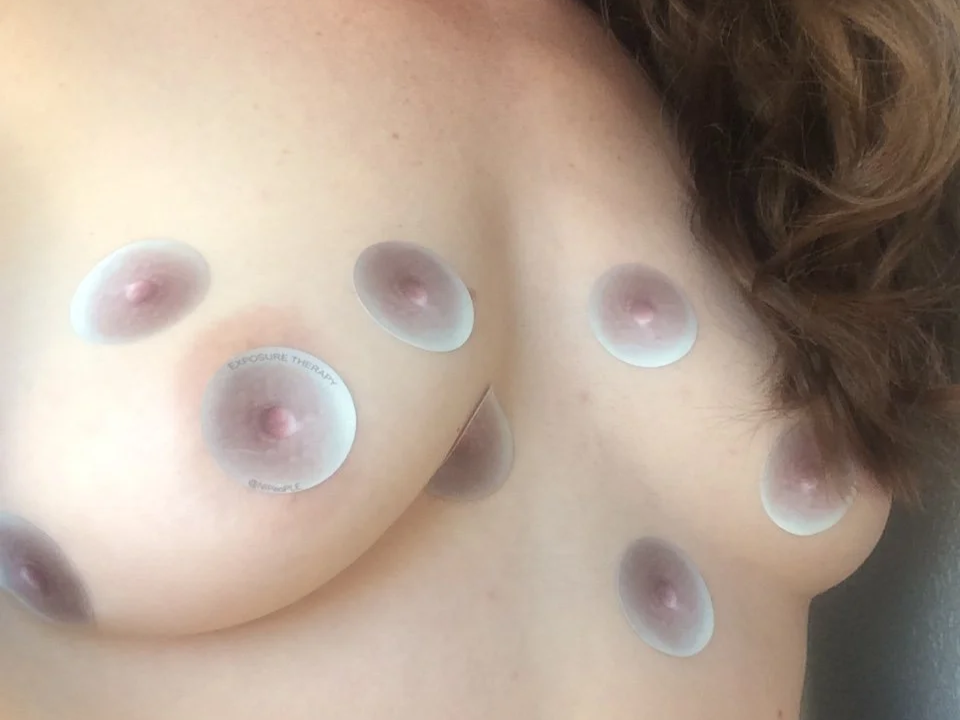
“Because it shows your nipples,” was the answer I finally pried out of the photo-desk manager.
Summoned by a poor embarrassed clerk who had spotted the offending nipples, she had appeared to tell me authoritatively that they would be destroying my prints, and that “ordinarily in situations like this we call the police.” A small group of employees and clients had curiously perked their ears towards this terse, awkward exchange that had by now been going on for about 5 minutes.
I was being naive—genuinely naive—to think I could get my art photos printed at the local Walmart. So there I stood: frightened, humiliated, furious, and, against my better judgment, curious. I have an irritating habit of needing to understand exactly why I must—or can’t—do something. It’s a trait that has served me to great (read: terrible) effect for most of my life, getting me benched during softball games, pushing away soon-to-be ex-boyfriends, and pissing off more than a few bosses. In this case, it also drew a crowd close enough to overhear the real answer: “Because it shows your nipples.”
They did, infact, destroy the prints that showed my nipples. But I walked out of the store with inspiration far greater than my shredded, forgotten artworks could have ever given me alone. It was here that began my long, surprising battle against nipple censorship.
That moment in a rural Walmart was, at that point in my life, inevitable. I was living in a blissful, hard-won ignorance, a bubble of bodily autonomy and non-judgement that was due to burst. I had always had a difficult relationship with my body, not much different from the experience of many of my female friends; it had resulted in depression, disordered eating, and general self-denigration for many years. What had broken that cycle was something seemingly contradictory but actually completely sensical: art modeling.
After I graduated from the Rhode Island School of Design, I was directionless, sapped of creative energy and doubting my voice. I found myself gravitating back to the old-fashioned atelier rooms that I had enjoyed at the beginning of my artistic journey, a comforting space frozen in art-historical time. But my painting degree hadn’t exactly set me up with a job, so I took the only option available that the local atelier school could offer me. Next thing, I had borrowed a robe from my sister, and was standing nude on a small stage as 40 eyeballs scanned, measured, and concentrated on my still, exposed body. It was–to use a tired phrase sincerely–liberating. It wasn’t at all like the scrutiny I subjected myself to in my mirror, no-one was naming my flaws or wishing I was any different; I was not even ME, I was something else. I was MODEL. I was art history.
Much can be, and ought to be, said about the history of women’s bodies in art. While my own experience was rarely objectification, there were undertones playing throughout all of it, to be sure. However, my personal epiphany that let me separate my judgement from my body was profound, and lasting. It gave me a way to love my body, to be kind to it, and to see its potential not its limitations. I spent the next 6 years as a full-time art model. I moved to New York. And eventually I rediscovered my own artistic voice, using my body as my language.
It was at that moment–when I had left New York to pursue my own art practice–that I found myself utterly baffled that nipples were the reason I was being shamed at a photo desk in Walmart. It felt like crashing into reality. And I was furious.
Furious because it had taken me so long to see my own body as more than a jumble of unacceptable parts. Furious because here was the world, again, to remind me that outside the atelier, the judgement I had banished was still waiting. I realized it hadn’t been something I needed to unlearn–it wasn’t my fault that I had been so hard on myself earlier in my life–it was something that the world wanted me to feel. That shame had been taught to me. It was the rule.
And so, as I left, cheeks still burning, the “Why?” I had been directing towards that manager turned outward. It became my own personal rallying cry, and I have yet to find reason to stop.
It is a kind of power, an incantation that can unravel the tangled sexism we’re caught in every day. Asking WHY finds the faults in logic. It refuses to accept blame unconditionally. It reveals hypocrisy.
And every time my artwork is removed, censored, or suppressed because of my nipples, I am back at that desk–asking the same question, demanding answers that expose not my shame, but ours.
by Emma Shapiro